
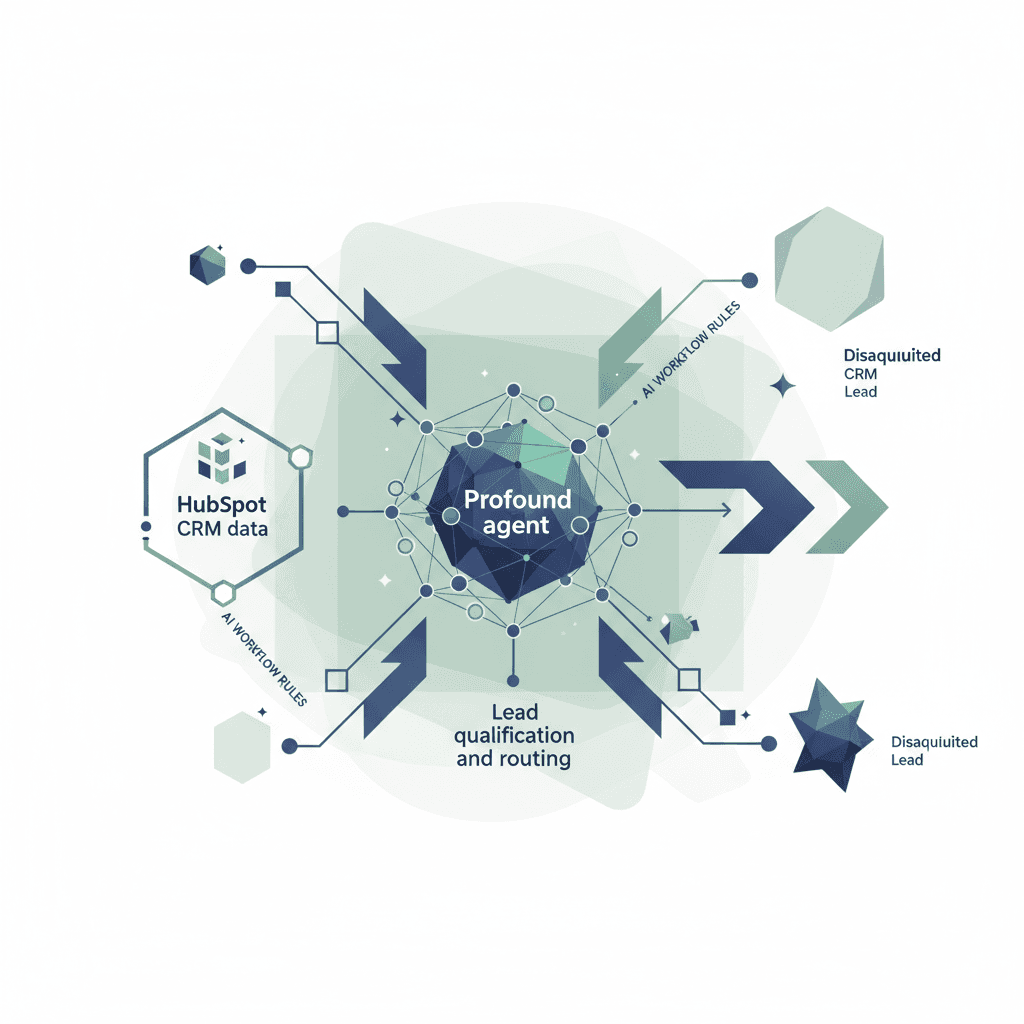
Can AI Agents Handle Lead Qualification and Routing in HubSpot?
Learn how AI agents apply workflow rules to HubSpot CRM data to qualify and route leads faster, with consistent logic and full audit trails.
Yes, AI agents can handle lead qualification and routing in HubSpot by evaluating CRM properties against machine-readable workflow rules the moment a record is created or updated. Instead of relying on rep judgment, the agent applies consistent if-then logic across firmographic, behavioural, and lifecycle data, then assigns the lead without a manual queue.
What Does It Actually Mean to Automate Lead Qualification with AI?
AI qualification agents do not just speed up a manual process. They replace a class of judgment calls that sales teams have never been consistent about in the first place. Reps apply different thresholds, skip fields under pressure, and forget to log outcomes. An AI agent applies the same rule every time against the same CRM data, without fatigue. This shift matters because inconsistency at the qualification stage compounds downstream: misrouted deals, inflated pipelines, and frustrated reps inheriting leads that should never have been passed.
SDR qualification consistency drops significantly when inbound volume exceeds 50 leads per day. At that volume, humans start triaging by instinct rather than criteria. They favour leads that look familiar, skip enrichment steps they know they should complete, and rely on memory rather than CRM fields. The result is a qualification layer that is inconsistent by design.
CRM automation removes that variability. HubSpot workflow automation enables rule-based triggers that fire within seconds of a property update, meaning a lead that submits a form at 11 p.m. is evaluated and routed before anyone arrives at the office the following morning. HubSpot reports that companies using workflow automation tools see lead response times cut by up to 8 hours on average, a window that directly affects whether a prospect speaks to a competitor first.
The older framing of "automation" as "doing the same thing faster" undersells what an agent-based qualification layer actually does. It makes qualification auditable. Every decision has a log. Every routing outcome traces back to a specific property value at a specific moment. That accountability changes how revenue teams manage their pipeline and how they diagnose conversion problems.
How does traditional lead qualification differ from AI-driven qualification?
Traditional qualification is rep-gated. A form submission sits in a queue until an SDR calls, asks qualifying questions, and makes a judgment call based on conversation and instinct. That creates a bottleneck at the SDR layer, where deal handoffs become inconsistent depending on who picked up the phone and how busy they were.
AI-driven qualification is agent-gated. The agent evaluates CRM properties at the moment of record creation or update, without waiting for human availability. Every lead goes through the same qualification tool, evaluated against the same criteria, producing a consistent decision. Traditional methods produce inconsistent deal handoffs because the criteria live in a rep's head rather than in machine-readable logic. Removing the queue does not just save time; it makes the pipeline more predictable.
What workflow logic does an AI agent apply to qualify a lead automatically?
AI agents apply machine-readable rules, not narrative instructions. Typical logic structures include:
- If-then conditional branches: If company size is greater than 200 employees AND industry is in a defined ICP list, qualify and route. If not, send to nurture.
- Threshold scoring triggers: Assign numeric points per property value; when the cumulative score crosses a defined threshold, the qualification workflow automation tools enroll the lead in the next stage.
- Multi-criteria AND/OR logic: Combine mandatory filters (correct territory) with weighted optional signals (email engagement score, page visit count).
- Sequence enrollment decisions: Based on qualification outcome, the agent enrolls the contact in a sales outreach sequence or a marketing nurture sequence automatically.
- Trigger events: Common triggers include form submissions, email replies, CRM property changes (e.g., lifecycle stage updated), and list membership changes.
The key distinction is that this logic is encoded structurally. It can be reviewed, version-controlled, and updated without changing rep behaviour.
Where HubSpot CRM data fits into the qualification decision
HubSpot contact, company, and deal records are the data substrate the agent reads. Properties like lifecycle stage, lead source, company size, industry vertical, and number of employees are the raw inputs that determine whether a contact clears the qualification threshold. HubSpot CRM stores over 1,000 contact and company properties that can feed these rules, giving qualification agents a dense signal set to work with.
For teams integrating AI with CRM records, the quality of those records determines the quality of the qualification output. An agent reading accurate, complete, recently updated data produces reliable decisions. An agent reading stale or incomplete data produces routing errors. The CRM is not just a system of record; it is the qualification engine's operating environment.
How AI Agents Read and Act on HubSpot CRM Data
Think of an AI qualification agent as a very disciplined analyst who has memorised every field in your HubSpot CRM and checks all of them in under a second. Where a human rep might skim three fields, the agent evaluates 20 simultaneously: company size, lead source, recent email engagement, deal stage, territory, job title, and more. It returns a decision based on the full picture, not the three fields that were visible above the fold on a contact record.
This is the core value proposition of agent-based qualification. The agent is not faster than a rep at making a phone call. It is faster at consuming structured data and applying logic to that data. That advantage only holds, however, if the underlying CRM data is accurate, complete, and current.
Which HubSpot contact and company properties AI agents use as qualification signals
A typical qualification ruleset may evaluate between 10 and 25 CRM properties per lead record. The table below maps the most common HubSpot property categories to their qualification use.
| Property Category | Example Properties | Qualification Use |
|---|---|---|
| Firmographic fit | Number of employees, company revenue, industry, country | ICP match: does this account fit the target segment? |
| Contact role | Job title, seniority, department | Authority signal: is this person a buyer or influencer? |
| Behavioural engagement | Email opens, page visits, content downloads, HubSpot score | Intent signal: is this contact actively researching? |
| Lead origin | Lead source, form submission type, campaign name | Channel quality: which sources convert at higher rates? |
| Pipeline context | Lifecycle stage, associated deals count, last activity date | Urgency: is there an existing relationship or active deal? |
| Data completeness | Missing required fields, last modified date | Routing readiness: is the record complete enough to qualify? |
The data quality of these properties directly determines routing accuracy. An agent reading a job title field populated with "asdf" will misclassify authority. An agent reading a company size field left blank will default to zero, potentially qualifying a company it should not. Naming, normalising, and maintaining these fields is a prerequisite to useful qualification automation.
For the platform to operate reliably, teams should audit which properties are consistently populated before writing qualification rules that depend on them.
How real-time CRM data updates trigger routing decisions mid-workflow
HubSpot's enrollment trigger mechanics allow a workflow to fire the moment a property changes, a form is submitted, or a contact joins a list. This means qualification is not limited to the moment of first submission. If a third-party enrichment tool writes a company revenue value to a HubSpot company record 90 seconds after the form submission, a second trigger can re-evaluate the lead and change the routing outcome before a rep ever sees the contact.
This mid-workflow re-routing happens without human intervention. The workflow builder monitors property states continuously, so a contact that initially looked like an SMB lead can be re-routed to an enterprise rep the moment firmographic data confirms the company has 500 employees. The automation layer does not need to be restarted; it responds to data state, not clock time.
Enriching sparse HubSpot records before qualification rules run
Many inbound leads arrive with minimal information: a first name, a business email, and a company name. Running qualification rules against that sparse record produces low-confidence decisions. The better architecture inserts a pre-qualification enrichment step: the agent calls an enrichment layer via the HubSpot CRM API documentation, writes missing firmographic fields back to the contact and company records, and then runs qualification logic against the enriched record.
CRM data enrichment before qualification is a foundational step that many teams skip, then wonder why their qualification accuracy is poor. Enrichment tools can fill in missing firmographic fields on a large share of sparse records, making the entire downstream qualification layer more reliable. This step should be modelled as an explicit node in the workflow, not an afterthought.
What happens when CRM data is incomplete or stale?
Incomplete or stale data produces specific, predictable failure modes. Leads get routed to the wrong territory segment because a country field was never populated. Deals get created for disqualified accounts because a company size field was empty and defaulted to zero, clearing the minimum threshold. Qualification scores get inflated because fields that should carry negative weight are absent rather than explicitly low.
Stale records, specifically those last updated more than 90 days ago, materially degrade routing accuracy because company size, funding status, or decision-maker tenure may have changed. Best practice is a data-freshness gate in the workflow: if the record's last-modified date exceeds 90 days, trigger enrichment before qualification rules evaluate it.
Teams that want accurate CRM data for qualification need to treat data quality as an operational discipline, not a one-time project. Routing precision is a direct function of data precision.
Building AI Workflow Rules for Lead Qualification in HubSpot
What separates a qualification rule that drives revenue from one that just moves leads around? The answer is almost always specificity: whether the rule encodes your actual ICP criteria or a vague approximation someone sketched in a spreadsheet two years ago. Qualification logic built on vague inputs produces vague outputs, and vague outputs mean reps spend time on leads that should never have reached them.
Building machine-readable qualification rules in HubSpot is not a technical exercise in isolation. It requires a prior conversation about what qualified actually means for your pipeline, translated into explicit CRM property conditions that a workflow engine can evaluate.
BANT has been a standard qualification framework since the 1950s. Modern qualification layers behavioural signals on top of those four dimensions, adding email engagement, content consumption patterns, and account-level activity to produce a richer picture of fit and intent. A well-structured HubSpot workflow can branch across up to 5 qualification tiers, from highly qualified enterprise accounts down to disqualified contacts enrolled in a long-cycle nurture track.
ICP fit scoring typically uses between 4 and 8 firmographic criteria simultaneously. The five-step process for encoding those criteria as machine-readable rules:
- Document the ICP criteria explicitly as named CRM properties with defined value ranges (e.g., employees >= 50, industry IN [list], country = CA or US).
- Map each BANT dimension to a specific HubSpot property so the agent has a concrete field to read rather than a conceptual category to interpret.
- Assign numeric weights to firmographic fit properties for scoring models, or define Boolean gates for mandatory disqualifiers.
- Layer behavioural signals from HubSpot email engagement, page activity, and content downloads on top of the firmographic foundation.
- Test the ruleset against 30 to 50 historical qualified and disqualified records to validate that the logic produces the expected output before going live.
Defining qualification criteria as machine-readable logic, not gut feel
Qualification logic must be expressed as explicit CRM property conditions. "A good fit" is not a rule. "Company employees is greater than or equal to 50, AND industry is in [SaaS, FinTech, Professional Services], AND lead source equals inbound web" is a rule. The difference matters because only the second version can be encoded in a workflow builder, evaluated consistently, and audited after the fact.
Translating criteria into explicit conditions also accelerates SDR onboarding. When qualification logic is written down as machine-readable rules rather than institutional knowledge, new reps can read the workflow and understand exactly what the team considers qualified. This reduces the ramp time for new hires and prevents criteria drift as the team turns over. The rule is the documentation. Using an agent to enforce it means the documentation is always applied.
How to layer BANT, ICP fit, and behavioural signals into a single ruleset
Layering qualification signals into a single ruleset requires mapping each BANT dimension to a specific HubSpot field, then adding firmographic and behavioural layers:
- Budget maps to the associated deal value field or a form field asking for estimated project budget. Flag records where deal value is below the minimum threshold.
- Authority maps to the job title and seniority properties. Define the accepted titles (VP, Director, Head of, C-suite) as an inclusion list.
- Need maps to a pain-point or use-case field on the intake form, or to page visit data showing visits to product or pricing pages.
- Timeline maps to a close date or urgency field (e.g., "When are you looking to implement?"). Records indicating timelines beyond 12 months can route to a nurture sequence rather than active sales.
- ICP fit adds firmographic filters on top of BANT: company size, industry, geography, and technology stack.
- Behavioural signals close the loop: email opens, content downloads, and marketing engagement scores reflect intent that BANT and firmographics alone cannot capture.
A composite score or branching condition set can combine all six layers into a single qualification decision. Referencing HubSpot lead scoring documentation provides a starting framework for assigning numeric weights to these dimensions.
Threshold scoring versus conditional branching: which model fits your pipeline?
Threshold scoring assigns points to property values and qualifies a lead when the total score reaches a defined cutoff, such as score greater than or equal to 60. Conditional branching uses a Boolean if-then tree to route before a score is computed, disqualifying a lead immediately if a hard-stop condition is met.
Threshold scoring suits high-volume inbound pipelines where most leads share a similar profile and nuance accumulates across many signals rather than living in a single disqualifier. Conditional branching suits enterprise deal pipelines where a single criterion (wrong territory, below minimum company size, no identifiable budget) should short-circuit the entire workflow without wasting further evaluation time.
Many teams run both: a conditional gate for hard disqualifiers, then a threshold score for the leads that clear the gate. The platform supports this architecture natively in HubSpot's workflow branching logic.
Handling edge cases and disqualified leads without dropping them from the CRM
Disqualified leads should not be deleted or ignored. They should be enrolled in a nurture sequence, tagged with a disqualification reason property, and scheduled for re-evaluation at 60 or 90 days. Disqualified leads typically represent 15 to 20 percent of future conversions when re-engaged at the right time, making the nurture track a legitimate revenue channel.
Before routing any lead, duplicate detection should run to prevent the same contact from being qualified and routed twice under different email addresses or slight name variations. Duplicate routing wastes rep time and creates conflicting deal records. CRM and marketing automation integration for nurture context should include deduplication as a standard workflow step, not an optional add-on.
Intelligent Lead Routing: Moving Qualified Leads to the Right Rep Fast
Research by Lead Response Management puts the odds of qualifying an inbound lead at 21 times higher if contacted within 5 minutes versus 30 minutes. Once an AI agent makes a qualification decision, the routing step must be equally fast. Manual assignment queues erase the speed advantage the agent just created. A lead that is qualified at 8:47 a.m. but sits in an assignment queue until 10:15 a.m. has lost most of the timing benefit the automation layer was designed to deliver.
Routing is not just about speed, though. It is about accuracy. A lead routed to the wrong rep, even instantly, still results in a delayed or failed first contact because the rep may lack the territory relationship, the product expertise, or the account context to have a productive opening conversation.
Routing rules need to encode both speed and accuracy criteria, and they need to log every decision so the team can diagnose failures after the fact.
How AI routing rules map qualified leads to territory, segment, or rep capacity
Routing dimensions typically include geographic territory (country, province, postal prefix for Canadian market coverage), company segment (SMB, mid-market, enterprise based on employee count or revenue), named account ownership for accounts already in a target list, and rep capacity measured by open deal count or a manually maintained availability flag.
In HubSpot, territory and segment are usually stored as contact or company properties that the routing rule reads at assignment time. A lead from Ontario with a company size of 150 employees in the FinTech vertical routes to the Ontario mid-market rep. A lead from British Columbia at an enterprise account already in the named account list routes directly to the assigned account owner. The sales team sees only pre-routed leads, each matched to their specific territory and segment profile, without manual triage.
Can AI agents re-route leads dynamically when rep availability changes?
Yes, with the right CRM data in place. If a rep's availability property changes, for example an out-of-office flag is set to true or an open deal count exceeds the defined capacity threshold, the agent checks that property before assignment. If the primary rep is unavailable, the workflow branches to a backup owner assignment rule.
HubSpot's workflow branching supports this conditional re-routing natively. The practical requirement is that rep availability data must be current in the CRM. If reps do not update their availability flags, the automation layer routes to the wrong person anyway. This is another data quality dependency: routing accuracy is bounded by the accuracy of the rep-level properties the team maintains.
Round-robin versus priority routing and when to use each
The table below compares the two primary routing models used in HubSpot qualification workflows.
| Routing Model | Best For | HubSpot Implementation | Risk |
|---|---|---|---|
| Round-robin | High-volume inbound at similar deal sizes; balanced SDR teams | Rotate assignment via sequence of rep-owner values in workflow | Ignores rep capacity; high-score leads go to the next rep in rotation |
| Priority routing | Variable lead score or deal value; senior capacity must be preserved for top accounts | Branch by lead score threshold before assignment; route top tier to named senior reps | Senior reps become bottlenecks if too many leads hit the top tier |
| Hybrid tier routing | Most production environments with mixed lead quality | Round-robin within each tier; priority logic determines which tier a lead enters | Requires accurate scoring to prevent tier misclassification |
For most B2B teams handling a mix of inbound volume and enterprise target accounts, the hybrid model is the most practical. SDR volume at the mid-market tier is handled round-robin. High-score enterprise deals route to priority reps. The qualification scoring model determines tier placement, so scoring accuracy becomes the upstream dependency for routing accuracy.
HubSpot Breeze AI provides native AI routing capabilities on certain paid tiers, which can be supplemented with custom logic via the API for teams with more complex routing requirements.
Logging routing decisions back into HubSpot for pipeline accountability
Every routing decision should write a timestamped note or custom property to the HubSpot contact and associated deal record. The log entry should capture: which qualification tier the lead was assigned to, which routing rules fired, which rep received the assignment, and the timestamp of the assignment event.
This data layer enables VP Sales to audit why a specific lead was sent to a specific rep, trace conversion outcomes back to routing accuracy, and identify systematic misroutes (for example, an entire segment routing incorrectly because a territory property was misconfigured). The CRM becomes the source of truth for both the routing decision and the pipeline outcome.
Teams building broader operational accountability frameworks will find the revenue operations process accountability context useful for governance design that extends beyond lead routing to the full GTM workflow.
Lead Scoring Improvements You Get When AI Replaces Static HubSpot Scoring
HubSpot's static point-based lead scoring was a significant improvement over pure rep intuition when it launched around 2012. It gave marketing teams a way to assign numeric value to behaviours and firmographic fit, making the handoff between marketing and sales at least partly measurable. But over a decade later, the model's core limitation has become a ceiling that AI-based scoring breaks through: static scoring does not learn from outcomes.
A static model assigns weights once. It reflects the beliefs of the person who built it on the day they built it. Market conditions shift, buyer behaviour changes, campaign mix evolves, and the ICP may narrow or expand. The score does not adjust unless a human manually re-weights it, which rarely happens on a consistent schedule.
Static scoring configurations typically degrade in accuracy within 12 to 18 months as these conditions change. Gartner data points to more than 30 percent improvement in conversion rates for organisations using AI-assisted lead scoring, suggesting the gap between static and adaptive models is material at scale.
Why static point-based scoring degrades over time
Static weights are set once and drift as buyer behaviour changes and campaign mix evolves. A form fill that signalled high intent in 2021 may indicate low intent in 2024 because gated content is now ubiquitous and prospects download white papers for research rather than purchase consideration. The marketing data in HubSpot reflects this change; the static score does not.
Similarly, the platform mix changes. If a team launches a new ad channel that attracts a different buyer profile, the lead source weight in a static model was calibrated on a previous channel distribution. The score inflates for a segment that converts at a lower rate. A human analyst might notice the drift in a quarterly review. An AI model recalibrates continuously.
How AI lead scoring models recalibrate on closed-won and closed-lost data
The feedback loop works as follows: the AI model reads closed deal outcomes from HubSpot, identifies which property combinations correlated with wins versus losses, and adjusts feature weights accordingly. This is supervised learning applied to the sales pipeline. Closed-won deals teach the model which signals matter; closed-lost deals teach it which signals are noise.
The minimum viable dataset for reliable recalibration is typically 200 closed deals, ideally 500 or more for statistical stability. Below that threshold, sample size produces noisy weights. Recalibration cadence is typically monthly or triggered on 50-deal intervals, whichever comes first.
HubSpot lead scoring provides the static model as a baseline. Breeze AI scoring, available on certain HubSpot paid tiers, adds adaptive recalibration within the native platform. Custom AI models can supplement or replace native scoring via the API for teams with specific pipeline characteristics that the native model does not capture. An agent that reads closed deal CRM data and updates score weights on a defined cadence is the practical implementation pattern for most mid-market and enterprise teams.
Measuring scoring accuracy: what metrics actually tell you the model is working
A scoring model that does not measurably improve pipeline conversion is adding complexity without value. The metrics that indicate a scoring model is working include:
- SQL-to-opportunity conversion rate: If AI-scored SQLs convert to opportunities at a higher rate than static-scored SQLs did historically, the model is producing better signal.
- MQL-to-SQL conversion rate change: A rising MQL-to-SQL conversion rate indicates the scoring threshold is set correctly and marketing is handing off contacts that meet the qualification criteria.
- Average deal size of AI-scored leads versus static-scored leads: Higher average deal size from AI-scored leads suggests the model is weighting enterprise signals appropriately.
- Routing accuracy rate: The percentage of routed leads that are accepted (not reassigned) by the receiving rep, indicating the routing logic and scoring tier are well-matched.
- Time-to-first-contact: Measures whether the qualification and routing automation is actually delivering speed-to-contact improvement, not just classification improvement.
Review these metrics on a 30 to 60 day cadence. A model that scores well in retrospective validation but does not move these numbers in production has a deployment or data quality problem, not a modelling problem.
Comparing AI Agent Qualification to Native HubSpot Automation
Comparisons between Salesforce HubSpot often frame this as a platform choice. The more useful framing for revenue operations teams is a capability-layer choice: what does native HubSpot automation handle well, and where does a dedicated AI agent layer add value that the native tools cannot replicate?
Native HubSpot workflows are powerful for rule-based routing and scoring. They run reliably, integrate natively with the CRM data model, and require no external infrastructure. The limitations appear at the edges: complex multi-signal reasoning, adaptive recalibration, and qualification logic that requires reading data from external systems not natively connected to HubSpot.
Marketing automation within HubSpot handles nurture sequences, list-based segmentation, and lifecycle stage transitions effectively. Where it is less suited is real-time, multi-source qualification decisions that require external data, probabilistic scoring, or dynamic re-routing based on rep-level CRM state.
The practical architecture for most B2B teams combines both layers: native HubSpot workflows for deterministic routing rules and sequence enrollment, with an AI agent layer handling scoring recalibration, enrichment orchestration, and edge-case routing logic that exceeds what the native workflow builder supports without significant manual maintenance.
HubSpot integration with external AI tools is supported via the CRM API and native app marketplace integrations. The contact center and revenue operations teams at companies running high-volume inbound pipelines typically reach the ceiling of native-only automation within 12 to 18 months of deployment, at which point a dedicated AI agent layer becomes operationally justified.
For service businesses with less predictable inbound patterns, the native HubSpot automation layer may be sufficient for longer periods. The signal that an AI agent layer is needed is typically one of three: qualification consistency complaints from senior reps, scoring model drift visible in MQL-to-SQL conversion rates, or routing accuracy problems that are costing pipeline.
Powered lead qualification at scale requires both the platform infrastructure and the logic layer to be designed intentionally. Neither component substitutes for the other.
Key Takeaways
- Encode qualification criteria explicitly. Every ICP filter, BANT dimension, and behavioural signal must be expressed as a named CRM property condition. Gut feel cannot run in a workflow.
- Data quality is a prerequisite, not a side project. Stale or incomplete HubSpot records produce routing errors. Build an enrichment gate into the qualification workflow before rules evaluate any record.
- Match routing speed to qualification speed. An AI agent that qualifies instantly but routes to a manual assignment queue loses the timing advantage. Routing rules must execute within the same workflow, not after a human handoff.
- Choose the right scoring model for your pipeline volume. Static threshold scoring suits high-volume SMB inbound. AI-adaptive scoring with closed-deal recalibration is justified when deal complexity and ICP evolution make static weights drift within 12 to 18 months.
- Log every routing decision. Accountability requires that every qualification and routing outcome writes back to the HubSpot contact and deal record with a timestamp, enabling revenue teams to diagnose conversion problems at the system level.
FAQ
Can HubSpot natively handle AI lead qualification without external tools?
HubSpot's native workflow engine handles rule-based qualification and routing reliably for most mid-market pipelines. Native Breeze AI scoring adds adaptive elements on paid tiers. The limits appear with complex multi-source qualification logic, external enrichment orchestration, or scoring models that need recalibration on closed-deal feedback loops. Many teams start native and add an AI agent layer when those limits become visible in conversion metrics.
What data does an AI qualification agent need in HubSpot to work accurately?
An AI qualification agent performs best when the following fields are populated consistently:
- Job title and seniority
- Company size (employee count) and industry
- Lead source and campaign name
- Lifecycle stage and last activity date
- HubSpot score or equivalent engagement metric
- Country and territory fields for routing
Sparse or stale records in these fields are the most common cause of misqualification and misrouting.
How does AI lead routing differ from standard HubSpot round-robin assignment?
Standard round-robin distributes leads sequentially across a rep list, ignoring lead score, deal size, territory, and rep capacity. AI routing reads qualification tier, company segment, geographic territory, and rep availability before assignment, placing the right lead with the right rep based on actual match criteria. Round-robin is fast and simple; AI routing is accurate. Most teams benefit from running round-robin within a tier and AI-based logic across tiers.
How many closed deals are needed to train an AI lead scoring model?
A minimum of 200 closed deals, both won and lost, is typically needed for a scoring model to produce statistically stable feature weights. At fewer than 200, sample noise makes the weights unreliable. For pipelines with longer sales cycles, accumulating that volume may take 12 to 24 months, during which the static HubSpot scoring model serves as the baseline. Recalibration should run monthly or on every 50 new closed deals.
What is the biggest risk in automating lead qualification with AI agents?
The biggest risk is treating automation as a substitute for well-defined qualification criteria. An AI agent applies rules consistently, but if the rules are poorly specified (vague ICP definitions, missing property mappings, no hard disqualifiers), the agent consistently applies bad logic at scale. The second risk is data quality: qualification accuracy is bounded by CRM data accuracy. Teams that automate before auditing their CRM data typically see routing errors increase, not decrease, in the first 30 to 60 days post-launch.
How does AI qualification apply to conference and event lead capture?
AI qualification logic applies directly to post-event lead capture workflows. Badge scans, form submissions, or enriched contact records from trade show interactions can be enrolled in a HubSpot workflow that qualifies them against the same ICP criteria used for inbound web leads, routes them to the rep who staffed the event or owns the territory, and enrolls them in a post-event follow-up sequence automatically. For teams managing event pipelines at scale, this is a significant efficiency gain over manual post-event list processing. See our guide on trade show and event lead capture automation for a detailed treatment.
Can the same qualification logic work across HubSpot and other CRM platforms?
The core logic, ICP filters, BANT mapping, behavioural scoring, and routing rules, can be designed in a platform-agnostic way. The implementation layer is platform-specific. HubSpot workflows use HubSpot's property model and enrollment triggers. Salesforce uses Process Builder or Flow. Pipedrive and Attio have their own automation layers. An AI agent sitting above the CRM via API can apply consistent qualification logic across platforms, writing decisions back to whichever CRM the team uses. See the Outport AI home for how we approach multi-platform revenue automation architecture, and browse the blog for implementation guides across common CRM stacks.